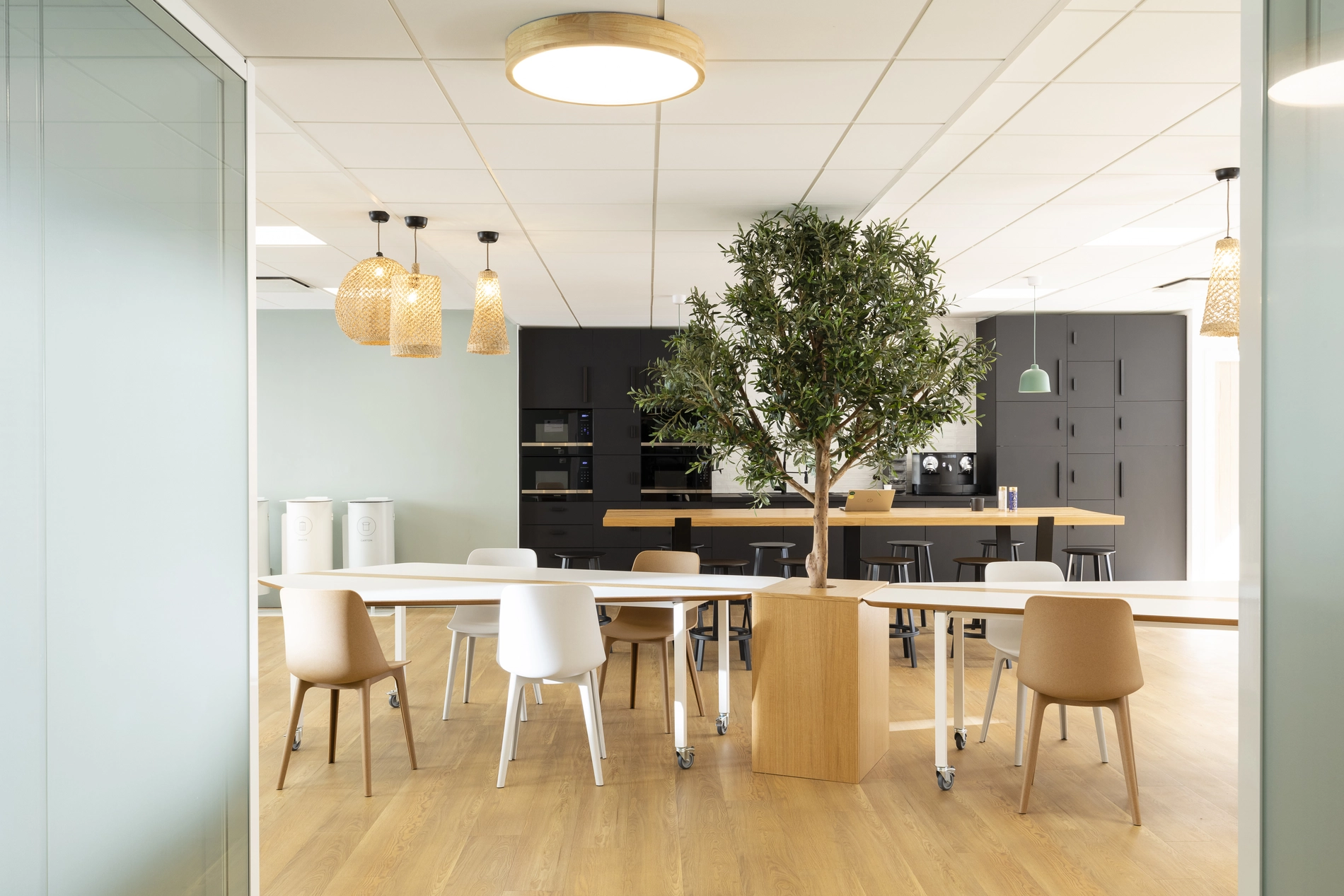



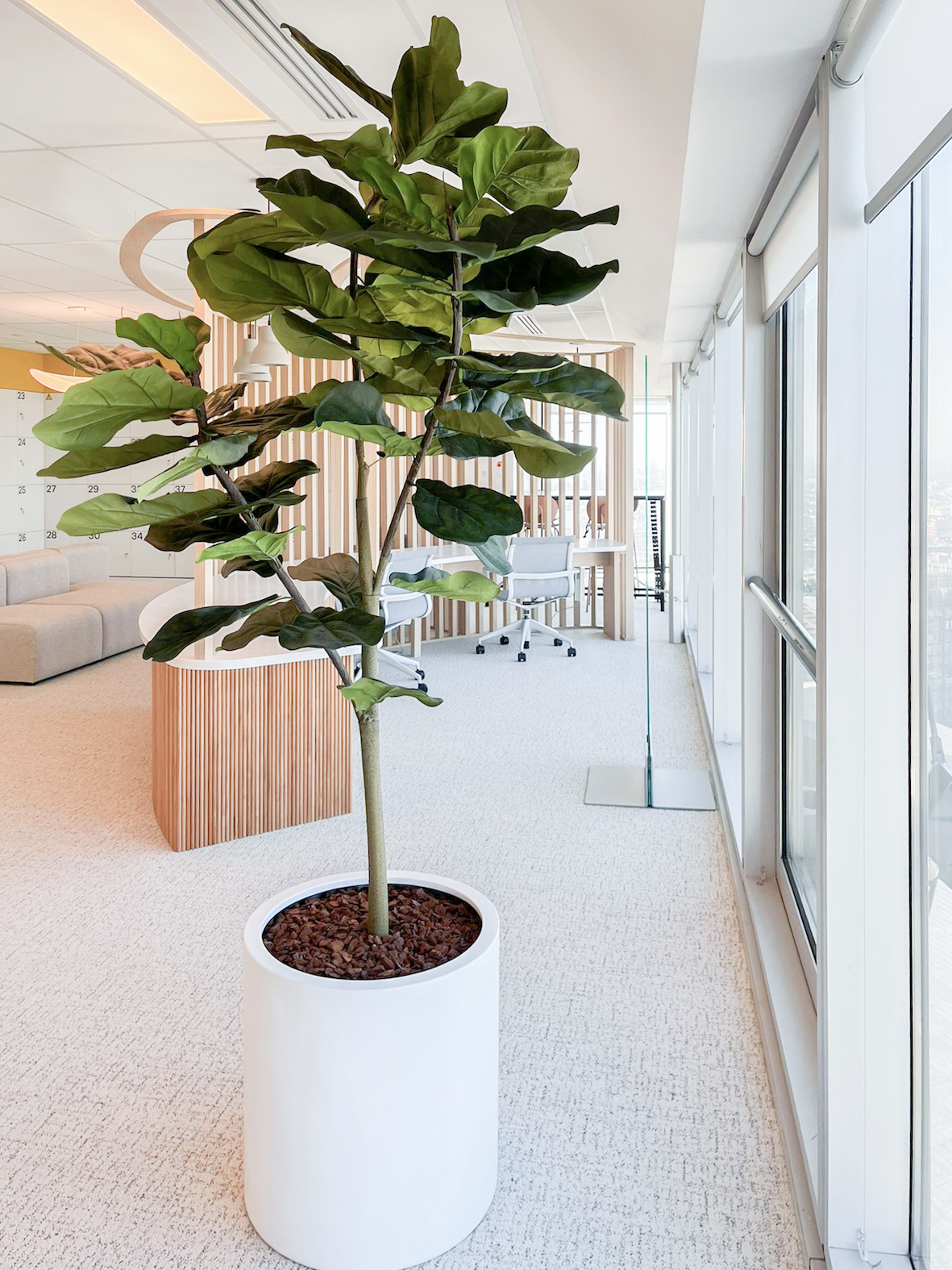
The aesthetics of a professional space play an essential role: they reflect your brand image, influence the mood of your employees and create a memorable first impression for your customers. Plants are one of the most popular decorative elements. Between the demanding upkeep of natural plants and the risk of seeing them wither away in unsuitable conditions, high-end artificial plants prove to be an ideal alternative. Far from the clichés of old-fashioned artificial plants, today it’s possible to find modern creations with stunningly realistic visuals, exceptional durability and perfect integration into all types of environments.
But with so much on offer, how do you choose the right artificial plants to enhance your professional space and meet your specific needs? In this comprehensive guide, we’ll answer all your questions to help you make an informed choice about high-end artificial plants.
Why choose artificial plants?
1. Minimal maintenance, no constraints
Natural plants, while beautiful, require constant care: watering, pruning, leaf cleaning, fertilization, and sometimes specific lighting. These constraints can prove problematic in a professional environment where time and resources are precious. Do you have a team who can manage this task? In this article, we give you some tips on how to look after natural plants.
Stabilized plants, on the other hand, although low-maintenance, still require certain precautions and are always fragile plants that cannot be integrated into any space. Artificial plants, on the other hand, require no maintenance whatsoever: no need to water, or monitor humidity or light levels.
This makes them ideal for professional spaces where simplicity and reliability are paramount. If you’d like to find out more about the 3 types of plant, take a look at our comparison guide.
2. Outstanding durability
Top-of-the-range artificial plants are designed to last for years, with no risk of dieback. Made from resistant materials, they retain their impeccable appearance over time. It’s a decorative object that doesn’t need to be handled, so it won’t fade. Once the artificial plant has been installed, its durability depends on very little else. For natural plants, its durability will depend on the environment, its maintenance, the soil, etc…
3. Total investment freedom
Natural and stabilized plants have specific requirements in terms of light, humidity and temperature. This sometimes limits their installation in certain areas (dark, air-conditioned or high-traffic areas). Artificial plants, on the other hand, can be placed anywhere. Whether in a windowless meeting room, a bright lobby or even near a heat source, they adapt without constraint. This flexibility makes it possible to create tailor-made arrangements without compromise.
4. Bluffing realism with high-end plants
Contrary to the outdated image of poor-quality artificial plants, today’s high-end artificial plants offer impressive visual and tactile rendering. Their meticulous design reproduces every detail: leaf veins, trunk textures, even the irregularities of natural plants.
5. Disadvantages of artificial plants
Their main disadvantage is the image of this decorative object that endures. “It’s made of plastic”, “It’s made in China”, these elements are real, but they don’t prevent you from having a quality object that’s less polluting than you’d imagine, provided you keep it for a long time.
6. Carbon impact of artificial plants
We had a study carried out by an ecological transition consultancy to examine the life cycle of plants and understand their environmental impact.
Taking into account product lifetimes, and taking an equivalent plant in the same Fiberstone pot, here are the results:
- – the artificial pot plant has the lowest carbon impact with 17kg of CO2
- – 23kg of CO2 for a natural plant (grown in Europe without fertilizers)
- – 47kg of CO2 for stabilized plants
- – 66kg for a natural hydroponic plant grown in South America
Which explains this result:
- – Natural tropical plants come from just as far away as artificial plants (South America vs. Asia).
- – Natural plants need a lot of water and fertilizers to grow and keep up with today’s consumer trends.
- – Natural plants come in refrigerated cargo and cannot be stacked. A cargo of natural plants is therefore not very heavy.
- – What costs a lot of CO2 for artificial plants is the plastic raw material and the manufacturing process. Artificial plants stand out for their unique combination of practicality, aesthetics and durability.
Compared with natural, stabilized plants, they offer a stress-free solution, perfectly suited to professional spaces requiring impeccable rendering and minimal maintenance, with less carbon impact. By opting for top-of-the-range artificial plants, you’re investing in a decoration that combines modernity and serenity, while freeing you from maintenance-related concerns.

What is a high-end artificial plant?
A top-of-the-range artificial plant is one that is very close to the real thing, thanks to details that make all the difference: for example, fabric leaves, malleable stems that can be positioned as desired, vein details on the leaves and details on the trunks.
It’s also a quality plant, as it promises to be resistant and durable over the long term. Touch is also important in assessing a quality artificial plant. That’s why plants with fabric leaves are so popular. To go into even more detail, today there are so-called “semi-natural” plants, which are maintenance-free but made from a combination of natural materials (such as wood) and artificial ones. These are often shrubs or trees, such as cherry, olive or Schefflera. Their trunks are made of wood, while the rest is made of PE and Tergal. It’s a great way to combine the natural and the artificial.
1. How are high-end artificial plants made?
Most artificial plants are manufactured by molding, using a common plastic: polyethylene. This is the plastic used to make packaging, bottles, tubes of cream, etc… It has a number of advantages: it’s lightweight, non-oxidizing, flexible, easy to clean and, above all, extremely hard-wearing.
Depending on the plant, other materials can be added, such as Tergal: a silky, softer polyester fabric that perfectly imitates the appearance of leaves. Obviously, these materials are derived from petrochemicals, and it is to be hoped that very soon there will be alternatives to this material, or at least to its manufacture. However, in terms of carbon impact, the durability and resistance of artificial plants makes them more environmentally friendly than natural or stabilized plants.
2. How to care for artificial plants
An artificial plant just needs to be dusted with a microfiber from time to time to keep its shine.
3. How much does an artificial plant cost?
While high-end artificial plants may seem expensive at the outset, they prove to be more economical in the long term. Unlike natural or stabilized plants, they require no maintenance (watering, fertilizing, replacing dead plants, or controlled air conditioning). Their durability makes them a particularly attractive choice for professionals wishing to cut costs while preserving a neat, welcoming decor.
4. Where can I buy top-of-the-range artificial plants?
Artificial plants can be found in well-known department stores such as Ikea or garden centers. For high-end plants, it’s best to turn to specialists. In order to offer top-of-the-range artificial plants, Tanaman is very demanding in its choice of suppliers.

The special features of Tanaman’s top-of-the-range artificial plants
At Tanaman, we offer ready-to-install potted artificial plants. There are different collections to decorate all types of spaces and create different universes. We offer artificial plants in pots, hanging baskets, planters, dividers and plant walls.
The pots in which you’ll find the plants are also top-of-the-range. They’re made from Fiberstone (stone fiber), Ficonstone (fiberglass), ceramic, sea rush, terracotta and fabric.
1. Handcrafted assembly in France
What makes us different is that we assemble our plants and pots in France. In fact, for an even higher quality finish, we seal the plants in the pots and dress the base with pine bark or pebbles, for example (finishing trim). This is what sets us apart.
2. Tailor-made products created with our design department And because we work by hand, everything can be modified: the pot and the finishing trim. Our sales team and design office can help you create the most beautiful plants for your space. We also offer creations such as “built-in planters” to decorate your furniture, or trees for table centerpieces.
3. Two showrooms to discover our plants and pots You want to be sure of top-of-the-range rendering?
Visit our showrooms in Levallois-Perret or Neuville-en-Ferrain to see our collections of plants, walls and other plant creations. You’re convinced by artificial plants, now let’s see how to choose the right ones for your space?
How to choose artificial plants for a professional office?
A well-decorated office enhances the well-being of your teams. That’s why you need to pay attention to your spaces and furniture. Teams need to feel comfortable and at ease. Forget all-white walls and no personalization: offices should be inspired by homes and, above all, hotels, a comfortable place par excellence! We give you a few tips here.
If you’ve already done your home decorating and just need to plant it, we can help you make the right choices from among all the artificial plant solutions available, for the most spectacular effect possible.
1. The benefits of artificial plants for offices
As we saw earlier, artificial plants offer a number of advantages, all the more so in a professional space. Once placed in a space, they’ll look good from day one, and won’t need to be moved or maintained. And, although we haven’t mentioned it yet, they won’t cause allergies. In fact, natural plants can bring pollen indoors, and soil can also bring mold. Both of which are very bad for the ambient air that employees can breathe.
2. Criteria for choosing artificial plants
The quality of materials The quality of materials is essential to guarantee a natural look. Top-of-the-range artificial plants use materials such as polyethylene or fabric, which finely reproduce the textures, colors and details of real plants. Choose models whose leaves feature various shades of green and realistic details, such as veins or irregularities.
What atmosphere do I want to create?
When it comes to beautifying a professional space, the choice of decoration and plants may seem trivial, but there can be a lot of thought behind it.
Plant dimensions and proportions : To get the best out of your plants, make sure you take into account the space and configuration of the room. Don’t put a large plant in the middle of a corridor.
To optimize decoration with plants, think of all the shapes they can take: planters on a bookcase, a tree in the center of a table, small plants on desks, large plants in halls.
Style and harmony with existing decor
Plants should help you accentuate the ambience you’ve created. Industrial, cozy, Scandinavian, colorful, it doesn’t matter – artificial potted plants should serve this decorating purpose. That’s why it’s important to choose the right plant species and pots.
For a modern, minimalist environment, opt for plants with clean lines, such as pampas grass or ficus lyrata. If your office has a warmer or vintage decor, plants like ferns or ficus lyrata can create a beautiful coherence.
Strategic locations for artificial plants in the office
-The hall
The entrance hall, reception and/or reception areas are the first spaces people pass through, so they need to be decorated with care. Plants can help you create a warm, welcoming atmosphere.
- -Open space
- The easiest way to add green to open spaces is with divider bins. They can be used to divide spaces. You can play with different heights depending on the models you choose: you can also place plants on shelves or storage units. And of course, you can place plants in corners, simply and effectively.
We’re sure you’ll be inspired by all these images and achievements. Our design office is also at your disposal should you wish to launch a project.